Basic Subtraction: Learning How to Take Away
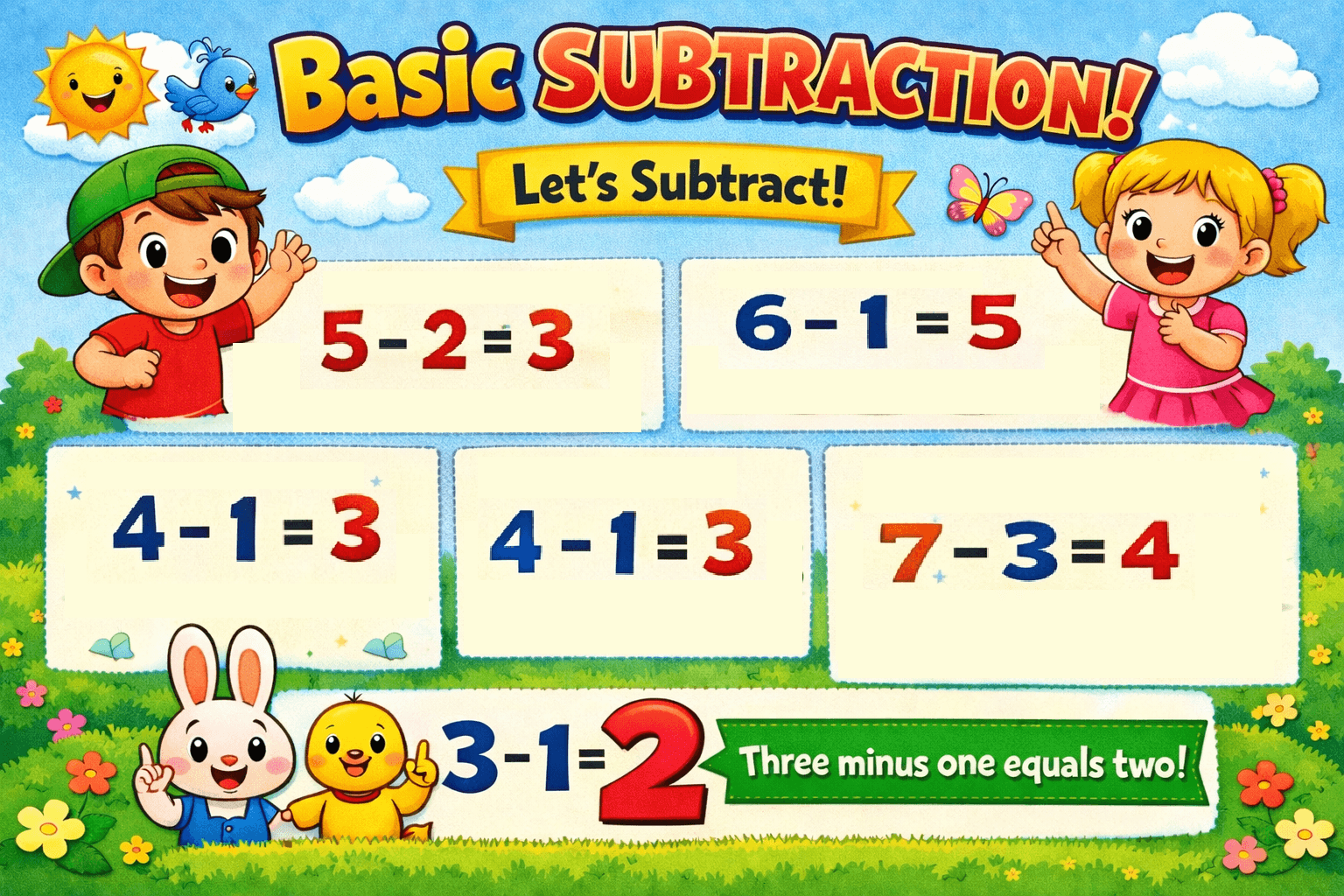
After children learn how to count and add numbers, the next important skill is subtraction. Subtraction helps us understand what happens when we take away objects from a group. It shows how the number of items becomes smaller. Subtraction is something we use in everyday life, like sharing snacks, giving away toys, or counting how many items are left.
Loading cards...
What Is Basic Subtraction? 📚
Basic subtraction is the process of taking away one number from another to find how many are left.
Subtraction uses the minus sign (−) and the equal sign (=).
Example:
5 − 2 = 3
This means if we start with 5 objects and take away 2, we will have 3 objects left.
Example with objects:
🍎🍎🍎🍎🍎 − 🍎🍎 = 🍎🍎🍎
5 apples minus 2 apples equals 3 apples.
Early math learning experts such as the National Council of Teachers of Mathematics explain that subtraction helps children understand how numbers change when quantities decrease.
Parts of a Subtraction Problem 🔍
A subtraction sentence has three parts:
- Minuend: the number we start with
- Subtrahend: the number we take away
- Difference: the answer or the amount left
Example:
6 − 2 = 4
6 → minuend
2 → subtrahend
4 → difference
Let’s Practice Subtraction! 🎯
1. Take Away and Count
Look at the objects:
🍪🍪🍪🍪 − 🍪 = ?
Take one cookie away. How many are left?
Answer: 3 cookies
2. Finger Subtraction Game ✋
Show 5 fingers.
Now fold down 2 fingers.
Count the fingers that are still up.
5 − 2 = 3
3. Subtract the Objects
Problem Objects Answer
4 − 1 ⭐⭐⭐⭐ − ⭐ 3 ⭐⭐⭐
5 − 2 🍎🍎🍎🍎🍎 − 🍎🍎 3 🍎🍎🍎
6 − 3 ⚽⚽⚽⚽⚽⚽ − ⚽⚽⚽ 3 ⚽⚽⚽
Why Learning Subtraction Is Important 🌟
Subtraction helps children:
→ Understand how numbers become smaller
→ Develop logical thinking skills
→ Solve real-life problems
According to the National Association for the Education of Young Children, hands-on learning activities help children understand mathematical concepts like subtraction more effectively.
Conclusion
Basic subtraction is an important math skill that helps children understand how quantities change when items are removed. By practicing with objects, fingers, and fun activities, children can easily learn how to subtract numbers. With practice, subtraction becomes a useful skill in both school and everyday life.
References
- National Council of Teachers of Mathematics. (2000). Principles and Standards for School Mathematics.
- National Association for the Education of Young Children. (2020). Developmentally Appropriate Practice in Early Childhood Programs.
- UNESCO. (2016). Early Childhood Care and Education Learning Framework.