Counting and Number Recognition: A Fun Guide for Young Learners
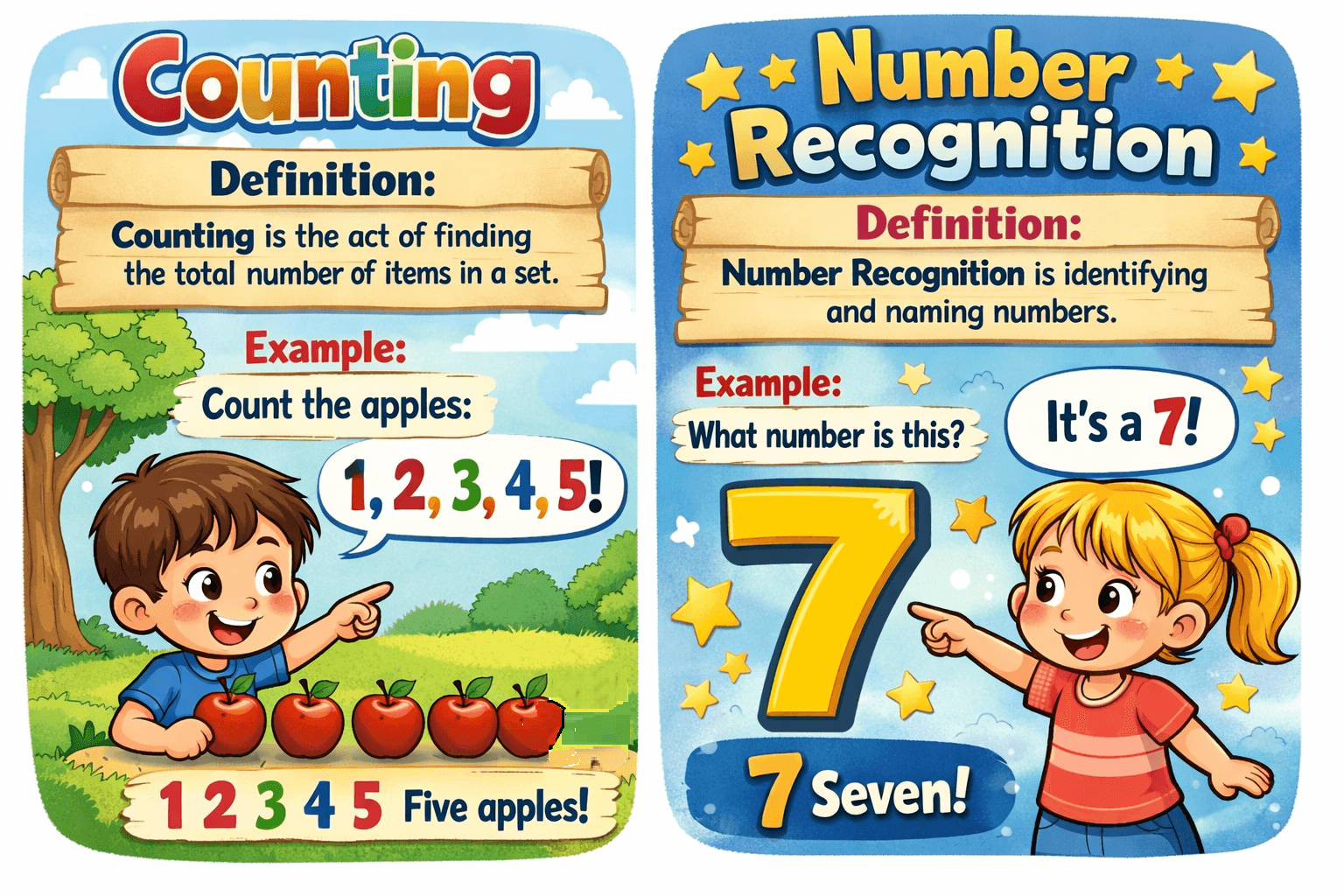
Numbers are everywhere 🔢✨! We use them when counting toys, sharing snacks, or even telling time. One of the first math skills children learn is counting and number recognition. These skills help children understand how numbers represent real objects in the world.
Loading cards...
What Are Counting Numbers? 📚
Counting numbers are the numbers we use to count objects or things. They start from 1 and continue in order:
1, 2, 3, 4, 5, 6, 7, 8, 9, 10, and so on.
These numbers tell us how many items are in a group. For example:
- 🍎: 1 apple
- 🍎🍎: 2 apple
- 🍎🍎: 3 apple
If you count the apples one by one, you are using counting numbers.
According to the National Council of Teachers of Mathematics, early experiences with counting help children build number sense, which is an important foundation for learning mathematics.
What Is Number Recognition? 🔍
Number recognition is the ability to identify numbers and understand what they represent. For example, when a child sees the number 5 and understands that it represents five objects, they are demonstrating number recognition.
Children learn number recognition by seeing numbers often in places such as:
- Books
- Clocks
- Fruits
Let’s Practice Counting! 🎯
Try these simple activities:
1. Count the Objects
How many stars are there?
⭐⭐⭐⭐
Answer: 4 stars
2. Finger Counting Game ✋
Use your fingers to show the following numbers:
Show 2 fingers
Show 4 fingers
Show 5 fingers
Try a Quick Challenge! 🧠
Can you answer these?
1. 🍌🍌🍌 = How many do you see?
2. Count from 1 to 10 aloud.
3. Look around your room and count how many chairs you see.
Why Learning Counting Is Important 🌟
Counting helps children:
- Understand quantity
- Develop problem-solving skills
- Build a strong foundation for math learning
Conclusion
Counting and number recognition are the building blocks of mathematics. When children practice counting objects, recognizing numbers, and playing number games, they develop important skills that will support their learning in school and everyday life. With fun activities and regular practice, learning numbers can be both exciting and meaningful.
References
- National Council of Teachers of Mathematics. (2000). Principles and Standards for School Mathematics.
- National Association for the Education of Young Children. (2020). Developmentally Appropriate Practice in Early Childhood Programs.
- UNESCO. (2016). Early Childhood Care and Education Learning Framework.