Symmetry: Discovering Balanced Shapes
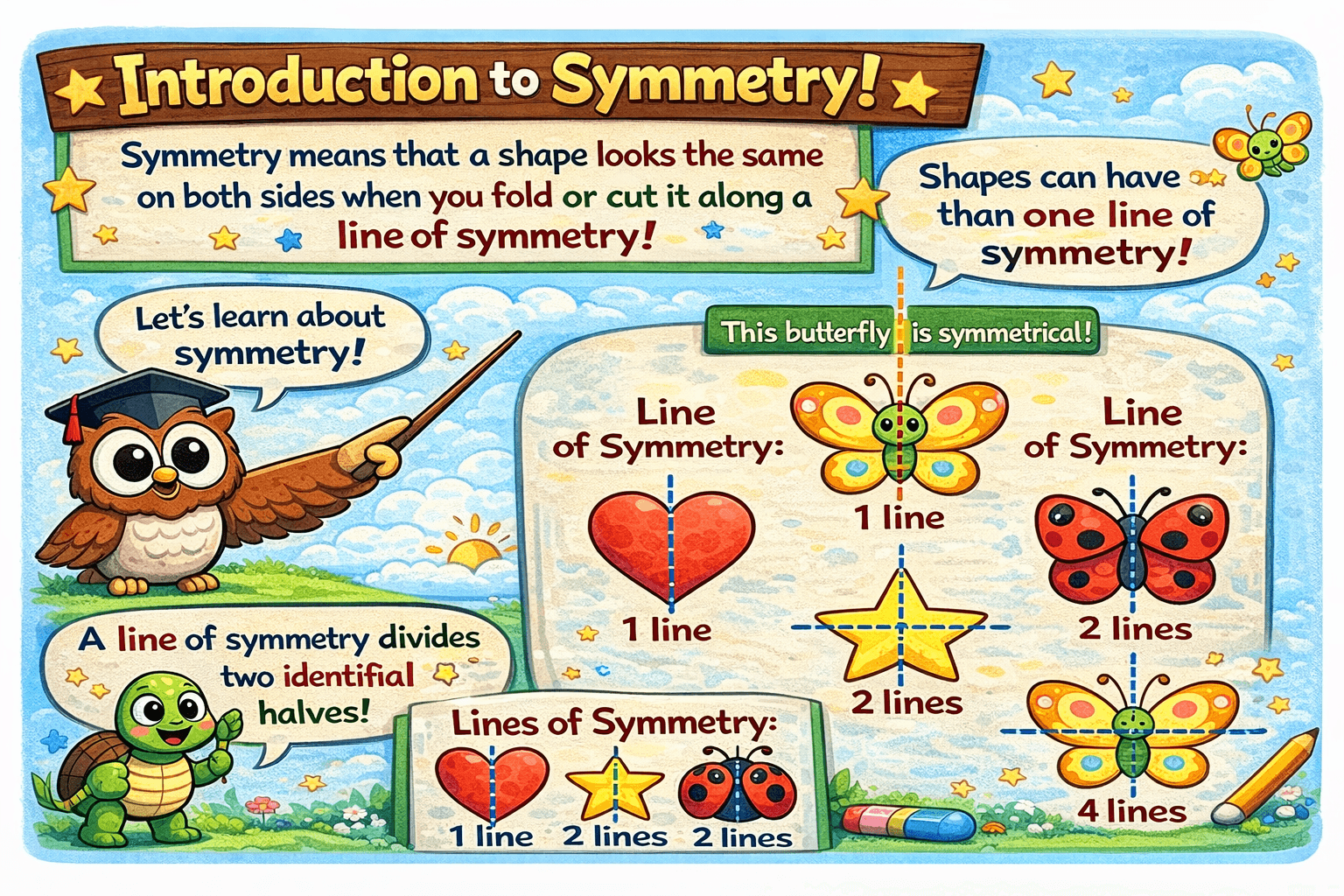
🪞✨ Have you ever seen a butterfly, a heart, or a snowflake and noticed that both sides look the same? This special kind of balance is called symmetry. Symmetry is an important idea in math, art, and nature. It helps children understand shapes, patterns, and balance.
Loading cards...
What Is Symmetry? 📚
Symmetry happens when one half of an object or shape is the same as the other half.
If you draw a line in the middle of the shape and both sides match perfectly, the shape is symmetrical.
The line that divides the shape is called the line of symmetry.
The Line of Symmetry 🔍
A line of symmetry is a line that divides a shape into two equal mirror images.
Example:
If you fold a symmetrical shape along the line of symmetry, both sides will match perfectly.
Examples of shapes with symmetry:
● Square
● Rectangle
● Circle
● Butterfly shape
Examples of Symmetry in Everyday Life 🌍
Symmetry appears all around us.
Examples include:
🦋 Butterflies – both wings look the same
❤️ Hearts – both sides match
❄️ Snowflakes – balanced patterns
🏠 Buildings – doors and windows often match on both sides
Nature uses symmetry to create beautiful patterns.
Shapes with Symmetry 🔺
Many shapes have one or more lines of symmetry.
Some shapes, like scalene triangles, do not have symmetry.
| Shape | Lines of Symmetry |
|---|---|
| Square | 4 |
| Rectangle | 2 |
| Circle | Many |
| Triangle (equilateral) | 3 |
Let’s Practice! 🎯
Problem 1
Does a square have symmetry?
Answer: Yes
Problem 2
Does a circle have a line of symmetry?
Answer: Yes — many lines of symmetry
Problem 3
Is a heart shape symmetrical?
Answer: Yes
Why Learning Symmetry Is Important 🌟
Understanding symmetry helps children:
● Recognize patterns and shapes
● Improve spatial and visual thinking
● Connect math with art and nature
Conclusion
Symmetry means that two sides of a shape are balanced and mirror each other. By exploring shapes, nature, and everyday objects, children can easily discover symmetry and understand how math appears in the world around them.
References
- National Council of Teachers of Mathematics. (2000). Principles and Standards for School Mathematics.
- National Association for the Education of Young Children. (2020). Developmentally Appropriate Practice in Early Childhood Programs.
- UNESCO. (2016). Early Childhood Care and Education Learning Framework.